Note from the Author: Years ago, I started a series called “Tactical Preschool.” The premise was simple: most people fail not because they don’t know “advanced techniques,” but because they haven’t mastered the fundamentals. Digging through my old notebooks, I found these doodles from 2009. They are as relevant today as they were then.
Fundamentals Over “Advanced” Noise
I have always been a believer in fundamentals over “advanced technique.” In the real world—where the lighting is bad, your heart rate is 160, and someone is actively trying to hurt you—complex motor skills disappear. What remains are the basics.
If you apply the fundamentals consistently and accomplish them faster than your opponent can process, you will typically win. It’s about shortening your OODA loop while stretching theirs.
The Lesson: Don’t Slug it Out
When confronted with superior numbers, the natural (and wrong) instinct is to stay put and try to out-slug everyone simultaneously. This is a recipe for a “static” disaster.
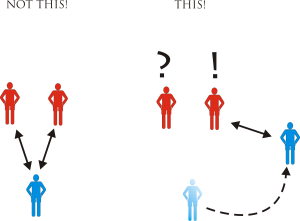
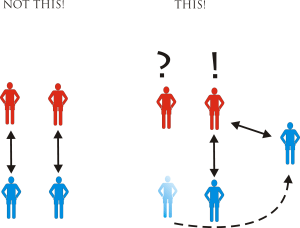
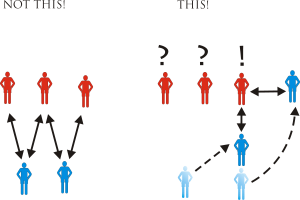
If you have to fight because fleeing isn’t an option, you must move. These sketches illustrate the basic flanking maneuver:
1. Displace to the Flank Do not stay in the “kill zone” where everyone can see you and hit you at once. Displace to one of the opponent’s flanks. This forces them to “re-index” on your new position.
2. The “Hombre a Hombre” Principle By moving to the flank, you isolate one opponent. You turn a “everyone vs. me” situation into a series of “one-on-one” engagements. You deal with him hombre a hombre.
3. The Buddy Factor If you have partners, two-on-one is even better. If the opponent’s buddy tries to help, he now has his own man caught in the crossfire. If you are lucky, the second bad guy won’t even realize you’ve moved until his partner is already out of the fight.
4. Rolling up the Line If you have enough “buddies” to keep the other threats occupied, you can roll up the flank and take out the opponents one at a time. This is the essence of tactical geometry.
The Preschool Graduation Requirement
“Tactical Preschool” isn’t about being basic; it’s about being brilliant at the basics.
Before you buy the latest optic, attend the “tier-one” carbine course, or learn the newest “operator” transition, ask yourself: Can I move and change the angle under stress? Do I understand the geometry of the room? Am I faster than his ability to process my movement?
If the answer is no, stay in preschool. The fundamentals are where the lives are saved.
The “Preschool” Checklist
- Movement: Are you moving to cover or moving to change the angle?
- Isolation: How are you turning a group threat into a series of individual problems?
- Processing: Are you doing it fast enough to break the opponent’s OODA loop?

Leave a comment