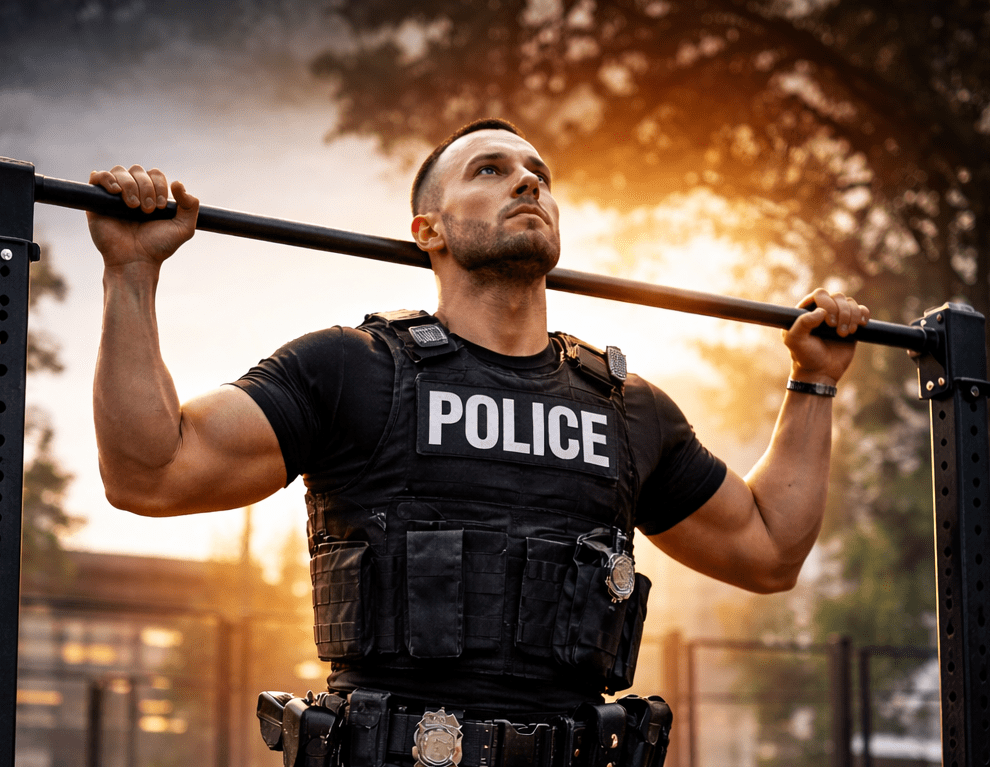
Note from the Author: In 2010, I wrote about a foot pursuit that fundamentally changed how I viewed fitness. Today, as I grind through my 14-week Murph cycle in my 50s, those lessons are more relevant than ever. This is a reflection on the intersection of the body and the mind—and why the hardest workouts aren’t about the muscles, but the will.
The Reality of the Street
Before I became a police officer, I used to watch reality TV shows and wonder why so many cops seemed out of shape. I’d watch a suspect vault a fence like it wasn’t there while the officer struggled to keep up.
A few months after finishing field training, reality hit me. My partner and I located a stolen car in a housing complex, and the chase was on. After a 100-yard sprint and two 6-foot chain-link fences, I was bleeding from both palms and had sliced the back of my leg. My legs felt like rubber.
I learned two things that day that aren’t taught in a standard gym:
- Gear changes everything: Running in boots, a vest, and a duty belt is a different world than “jogging” in shorts.
- Energy systems matter: The sprint-and-climb exertion of a pursuit taps into different systems than a steady 5K.
I caught my guy—mostly because my “wind” lasted one second longer than his—but I didn’t “win” the fight as much as I just fell on him and got the cuffs on. My fitness goals changed that afternoon. I realized I didn’t need a beach body; I needed a stress-inoculated body.
Beyond the Physical: Embracing the Suck
There is a term used by soldiers to describe dealing with a nightmare situation: “Embrace the Suck.” It means the situation is bad, but you put your head down and drive on.
As Mark Rippetoe famously said, “Strong people are harder to kill than weak people and more useful in general.” I agree 100%, but I believe the real benefit of intense exercise is mental development rather than physical results. Size and genetics have limits, but the space between your ears is a level playing field.
Intense exercise—the type that makes your internal dialogue scream, “This sucks, just stop, just quit”—is where you sow the seeds you will reap later when you are fighting for your life. When both you and your opponent approach the “quitting point,” the one who has practiced pushing through that threshold in training is the one who goes home.
The Standard of 2026
Military trainers have known this forever. Basic training isn’t just about “whipping recruits into shape”; it’s about showing them they can push beyond self-imposed limitations.
This is why I gravitate toward high-intensity protocols like CrossFit, maximal effort lifts (squats, deadlifts, presses), and the grueling 14-week Murph cycle I am currently executing. It’s why I pushed for my Adirondack 46er status. Whether it’s 100 burpees or a 4,000-foot ascent, the goal is the same: Stress Inoculation.
If you are comfortable in your workout, you are likely coasting. To truly benefit, you have to find that “lungs burning, gonna die” moment on occasion. You have to change things up. If you hate running, run. If you hate lifting, lift.
The Bottom Line
Training hard isn’t about cosmetic improvements. It’s about building a mental toughness that translates directly to the street, the trail, and the challenges of leadership.
Get out there and embrace the suck. It might be the best decision of your life. It could also be the one that saves it.
Questions for the Practitioner
- The Threshold: When was the last time your internal dialogue told you to quit, and you chose to ignore it?
- The Gear: Do you ever train with the weight you actually carry in the field?
- The Comfort Trap: What part of your current fitness program have you put on “autopilot,” and how will you disrupt it this week?

Leave a comment