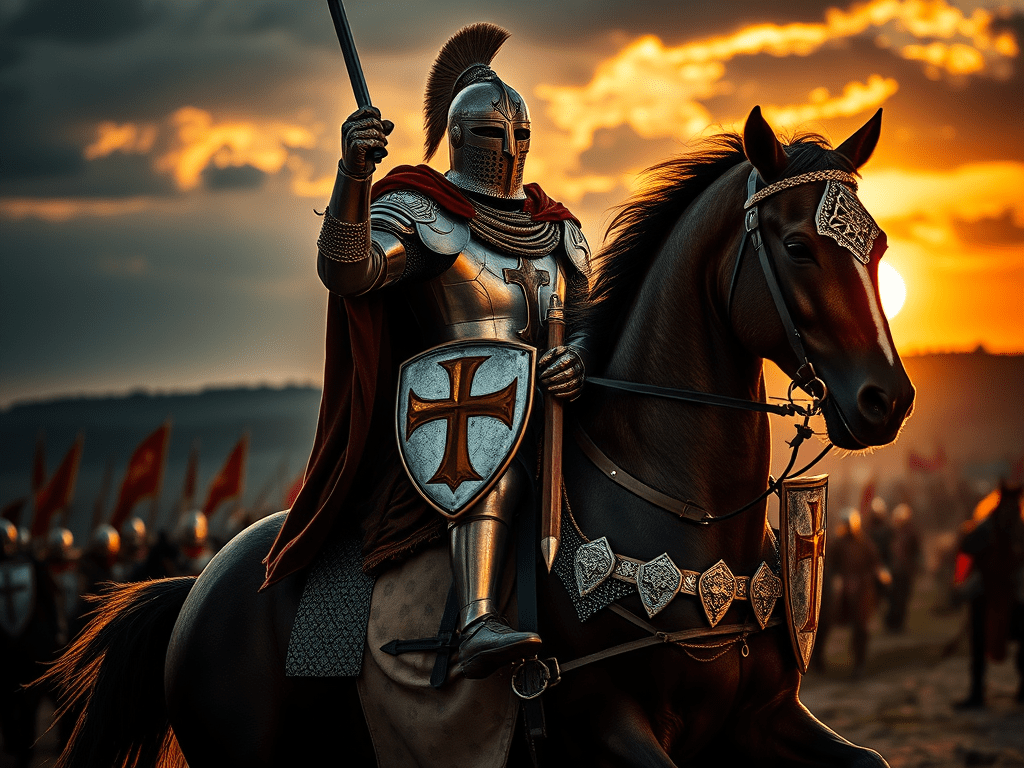
The term “chivalry” is well-known, but its historical meaning is a moving target. It has been a company of mounted knights, a social class, a legal term for land ownership, and—in texts like The Song of Roland—a shorthand for worthy action on the battlefield.
The Power of the Horse
The Age of Chivalry was, fundamentally, the age of the horse. The Knight was a mounted warrior, and his power on the battlefield was derived from the speed and crushing weight of his charger. It is etymologically appropriate that the word chivalry stems from the Latin caballus (“horse”).
This is an important distinction for the modern practitioner: Chivalry began not as a polite gesture, but as the management of superior power.
The Evolution of the Code
From the 12th century onward, chivalry shifted from a tactical description to a moral, religious, and social code. While the particulars varied by region, they centered on three pillars: Courage, Honor, and Service.
In his work Chivalry, Leon Gautier identified ten “commandments” of the code. While some are products of their time, several remain the bedrock of the modern protector:
- Thou shalt respect all weaknesses, and shalt constitute thyself the defender of them.
- Thou shalt never lie, and shall remain faithful to thy pledged word.
- Thou shalt be everywhere and always the champion of the Right and the Good against Injustice and Evil.
Ideal vs. Reality
In practice, chivalry was never free from corruption. By the late Middle Ages, courtly love often devolved into promiscuity, and pious militance into barbarous warfare. Eventually, the outward trappings of knighthood declined as wars were fought for cold victory rather than individual valor.
The Practitioner’s Takeaway
As I have noted before, historical failures do not invalidate the worth of the code. The value of chivalry isn’t found in a perfect historical record, but in the effort to live up to an honorable ideal. We study these ancient codes because they remind us that power without a standard is merely thuggery. We aren’t looking to play-act as medieval knights; we are looking to carry their highest aspirations into the modern world. In the end, we can only do the best we can where the rubber meets the road.

Leave a comment