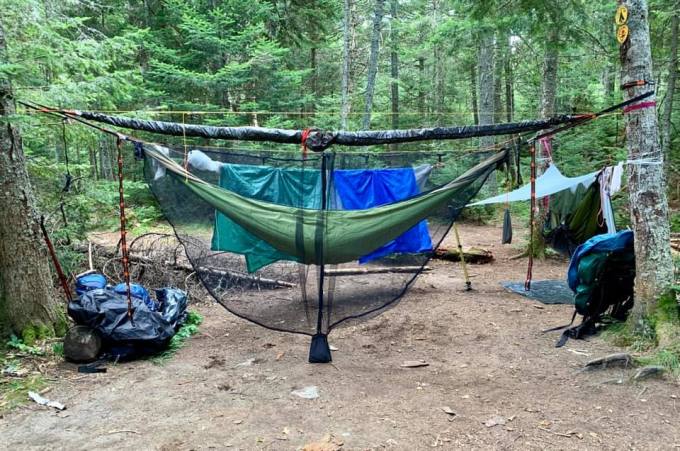
I’ve recently become one of those Hammock Campers you may (or may not) have seen out in the woods. I was sort of peer pressured into it by my buddy Paul who had been experimenting with them before I had any interest. I had a tent already and I was (ok..maybe “am”) a bit of a tightwad who wasn’t all too interested in spending the money on an entirely new sleep system when I already had a working one.
Eventually I caved in, and have left the tent at home in favor of my hammock set-up ever since. Are they “better” than tents? Well, like everything in life your decisions/choices come with advantages and disadvantages and those will change depending on the opinions of the person you are talking to. Personally?
DISADVANTAGES:
- Setup Time: This will vary depending on your experience and rig, but it does take longer to get everything set up vs most tent systems. There’s definitely more of an “art” to set-up vs popping up a tent.
- Weight: While not really a “disadvantage”, the overall weight of the hammock, tarp, tree straps, underquilt, bug net, etc is not all that much lighter than a tent. And unlike a tent where you can divvy up the poles, stakes, fly, footprint, etc, for 2 or more people who will be using the same tent; if you are all using hammocks you all have to carry your own gear. Sure you could sleep two to a double sized hammock, but that will depend on just how close you are with your camping partner (and it wont be comfortable).
- You need trees (by and large). Sure there are ground set-up techniques where you can use the hammock on the ground or you can use poles, branches, etc to rig something up but if you are in terrain without a lot of trees hammocks wont be your best option.
- Exposure: Again, not really a disadvantage as much as it’s a preference, but even with a tarp over you, there is more of an “under the stars” feel to sleeping in a hammock than the “indoors” sensation of crawling into a tent. Personally that’s an advantage to me. Others may have different preferences.
ADVANTAGES:
- You can set up anywhere you can find two trees. Wet ground? Uneven ground? Rocks? Tree Roots? Steep wooded slope? No problems.
- Adjustability: You can set up the hammock alone and hop right in if it’s warm enough, bugs are not a problem and it doesn’t look like rain. You can set up the tarp but not deploy it if you want to sleep “under the stars” but want a quick deployment if rain does come. You can sit in the hammock like a camp chair or sleep laid out in it. Set up your tarp like a rain-fly or like a porch. You can use the tarp minus the hammock if you just want to set-up a quick temporary rain shelter. You can also upgrade portions of your system as you see fit.
- Comfort: I was skeptical of just how comfortable this would be, but comfort is probably the biggest sell if you set your system up correctly. You can elevate your feet after a long slog. You are not hauling yourself up to a standing position from the ground when you wake/get-up. Hell if you are a dude and you feel the call of nature in the middle of the night you don’t even need to stand up if you can hang what you need to hang over the edge of the hammock. I’m not a back sleeper, but I have found myself sleeping on my back quite often in a hammock. And you can side sleep quite easily if you want to anyway.
The hammocks themselves are not very expensive at all. Decent quality ones can be had for as little as $30 but the hammock itself is only one piece of gear you are going to have to get. If you want to keep the rain off of you you will need a tarp. Bugs? A bug net. Want to stay warm at night? An underquilt or a ground mat of some sort (quilts are easier to deal with). Of course you could get a hammock system that has the tarp and bug net built in. Advantages, it’s an all in one system that faster to set up. Disadvantages? There’s no flexibility with many of them, the hammock, net and tarp are all one unit.
COMPONENTS: Bear in mind, I’m no expert so the following is as best as I currently understand it….
HAMMOCKS: The Hammock itself is a relatively cheap item. Most of them are just large sheets of nylon/synthetic/parachute material gathered at each end. Many will have a carabiner type clip attached at either end and a stuff sack sewn right to the edge of the hammock so that it all stuffs right “into itself”. The sack can also be used to store items in when the hammock is deployed. Hammocks can be found with a few options:
- Single vs Double: That’s simply the size. A “single” is designed for one person while a double (in theory) is designed for two. In actuality few people really sleep two to a hammock. The extra size of a double is advantageous for “diagonal lay”. In essence, instead of laying right down the middle of the hammock you turn yourself diagonally inside of it, this gives you more of a flat lay vs a head and feet higher than your butt type hang.
- Single or double layer: A hammock can be “one ply” or “double ply”. The double layer hammock is designed to let you slip some form of insulation between the layers. They are heaver than single layers, but with a single layer you have to either body surf a sleeping pad under you or buy an underquilt…more on that.
INSULATION: The “thing” with hammocks is that you can wind up colder than you can in a tent on a ground mat. When you are hanging in the air, the air moving around you will blow your body heat away pretty rapidly. In hot summer months that can be a plus. When it’s getting into the 50’s at night, not so much. Even on a relatively warm night, a breeze blowing under you can leave you uncomfortably cold at night.
You may think a sleeping bag would be enough, but the insulation under you gets crushed under your body and looses its insulation value. On the ground your ground mat keeps your underside warm, not your bag. Being warm on top, where your sleeping bag has retained its loft and insulation value, and cold on the bottom, where it’s crushed is called “Frozen Butt Syndrome” among hammock campers. You basically have a handful of options to stay warm.
- Sleeping pads. You can put a sleeping pad in your hammock and get on top. Works if you can stay on top all night. They are also not great at keeping your “edges” warm (shoulders, arms, legs) if they touch the uninsulated hammock material. There are “hammock specific” pads designed with “wings” you can get if you want that option. As stated before a double layer hammock lets you put a pad between the layers so it stays locked in place overnight.
- Underquilts: An underquilt is pretty much a “half of a sleeping bag” that you suspend under your hammock. This way you have insulating material (and a couple inches of body heated air) under your hammock. You can then sleep in a sleeping bag or with an “overquilt” (basically a zipperless sleeping bag you use like a blanket) over you and you can be toasy warm.
BUG NET: If there are bugs, you are gonna want one. If you are buying this stuff piecemeal (vs one of the integrated systems) keep in mind that skeeters can get you through the thin hammock material (underquilts can protect you from that) so get one that encapsulates your hammock.
TARPS: You are in a hammock, there’s open sky above you. To keep dry, or shaded if it’s sunny and hot you will want a tarp over you. There could be an entirely separate post on tarps, their uses and all the options you have for deployment. Suffice it to say that you want something large enough to cover your hammock end to end and then some. If it rains and the water is landing on the hammock material it will wick through it and you will get wet.
- Snakeskins: Snakeskins are tubes of material that slide over the tarp from either end. It keeps all the material contained until you want to deploy it (pictured in the photo for this post). If it’s going to be a clear night and you don’t want to “enclose” yourself under a tarp you can leave the skins on. If it happens to rain you just slide them off and stake the tarp down (have them in place in advance though).
- Line/rope: You will need a system if cordage to hang your tarp. Paracord is everywhere, but paracord will stretch and loose tension with use, with age and when wet. Modern line made out of Dyneema (Zing-it/Lash-it) is stronger, lighter and wont stretch. Well it probably does stretch somewhat, but not so that you would usually notice it.
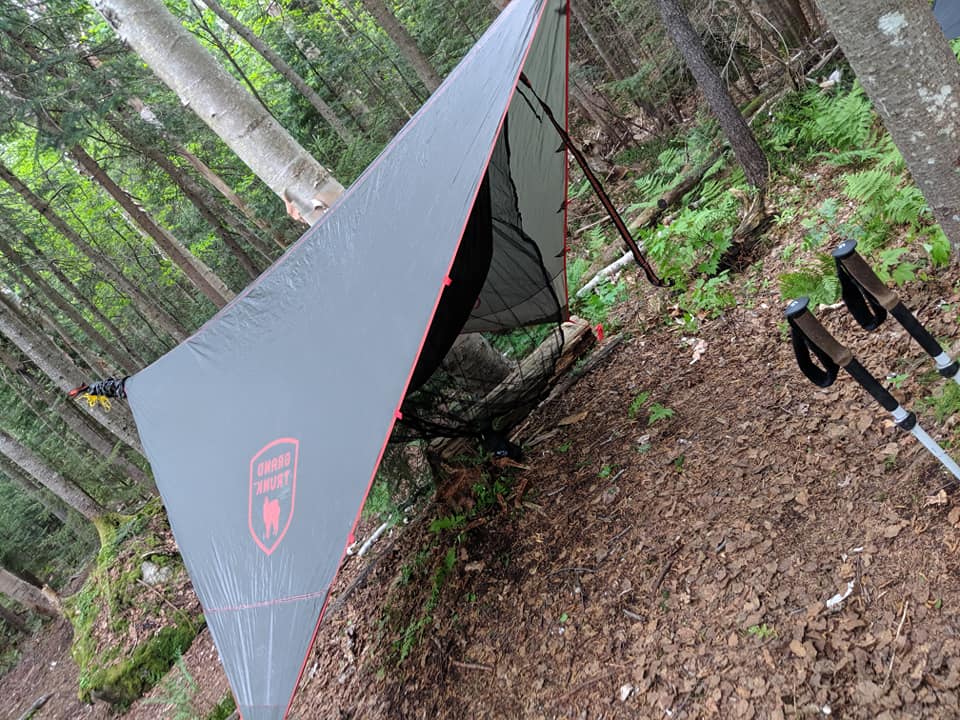
SUSPENSION: To hang a hammock you have to connect between two points. In the woods that’s usually going to be trees. Some hammocks don’t come with anything more than the hammock so you may have to consider what to use.
- The hammock I purchased came with ropes covered with fabric sleeves (to protect the trees from rope damage). You wrap the ropes around the trees and clip the carabiners on the hammock to them.
- Many folks, like me, opt for Tree Straps which are lengths of webbing with loops sewn into them. Straps get wrapped around the tree and you select one of the loops to clip into to adjust the tension of the hammock. With the rope slings you have to tie knots/loops to do that, so straps are easier there. Straps are also more tree friendly since they wont bite into the bark.
- There are also lightweight “line only” options like Whoopie Slings, (google them) where you can ditch the carabiners to save weight, but you need a little more knowledge/skill to set them up.
MISCELLANEOUS: This post wasn’t intended to be a complete dissertation on everything to do with hammocks and I’m sure I missed some vital points, but before I end here are a few points/tips as they come to mind.
- Get good at quick tarp deployment. Whats nice about carrying a tarp is that you can set it up and have a dry spot to work in and stash your gear.
- Water Breaks/Drip Lines: Rain can hit your tree ropes/straps/Whoopie Slings and flow down them to your hammock and/or quilt and get them soaked. This can be avoided by tying a piece of line or placing some other option/system between your lines and your hammocks to convey water away from you.Another tip in this same vein, and something I just learned and will do from now on, if you hang your tarp with a “ridgeline” (one long line between the trees vs tying separate lines to each end of your tarp) deploy the tarp with the line over the top of the tarp vs under it. Water can flow along that line and drip on you if its under the tarp.
- Ridgeline: A ridge line is a piece of cord/line that you can attach to each end of your hammock. If you get the length of it correct it can assure that the “sag” of your hammock is always the same no matter how you attach it to your tree straps.

Leave a comment